
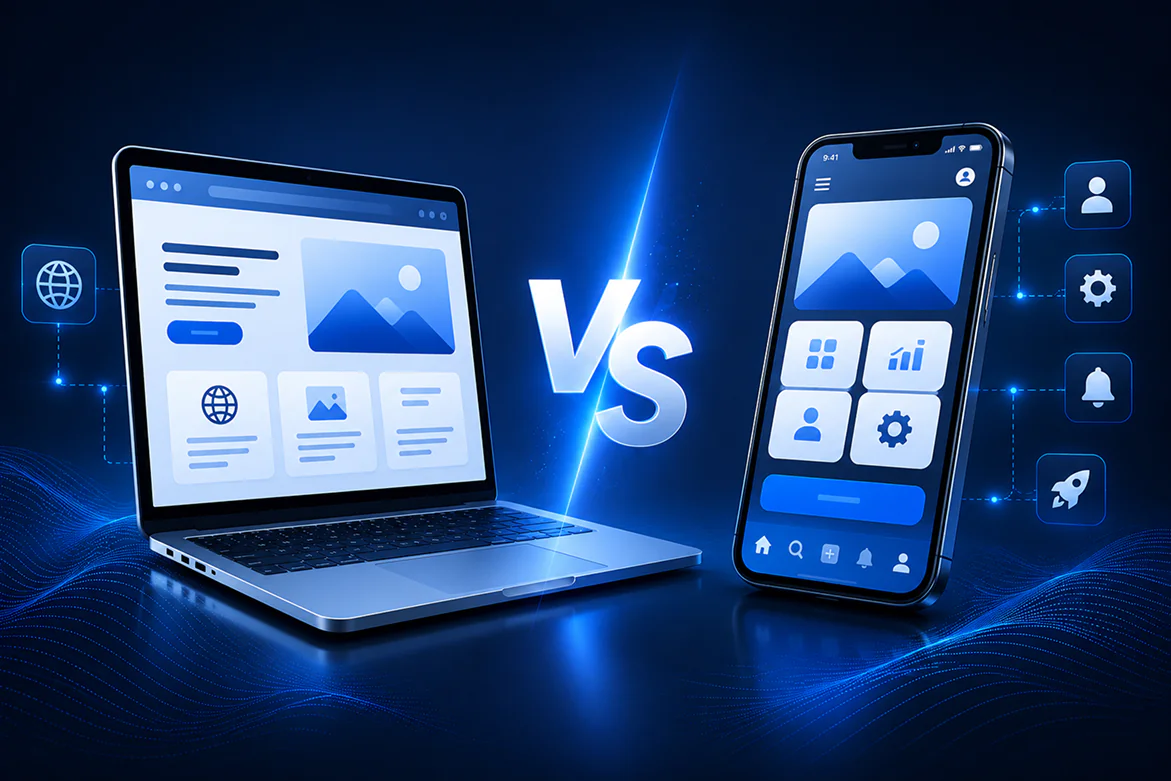
In today’s digital world, every business needs a strong online presence to stay competitive. Whether you’re launching a startup, expanding your business, or taking your services online, one common question arises:
Should you build a website first or invest in a mobile app?
The answer depends on your business goals, target audience, budget, and the type of experience you want to provide. Both websites and mobile apps offer unique advantages, but choosing the right one at the right time can save money, improve customer engagement, and accelerate business growth.
In this guide, we’ll compare websites and mobile apps to help you decide which solution is the best investment for your business in 2026.
Understanding the Difference
Before making a decision, it’s important to understand what each platform offers.
What is a Website?
A website is a collection of web pages that users can access through any internet browser on desktops, tablets, or smartphones. It serves as your digital storefront where customers can learn about your business, explore services, contact your team, or purchase products.
A professional website can include:
- Company information
- Service pages
- Product catalog
- Online store
- Blog section
- Contact forms
- Live chat
- Customer reviews
Since websites are indexed by Google, they help businesses attract organic traffic through Search Engine Optimization (SEO).
What is a Mobile App?
A mobile app is software designed specifically for smartphones and tablets. Users download it from the Google Play Store or Apple App Store, allowing businesses to provide faster, more personalized experiences.
Mobile apps often include features such as:
- Push notifications
- Offline access
- GPS location
- Camera integration
- Mobile payments
- User accounts
- Personalized dashboards
Apps are particularly useful for businesses where customers interact frequently with the platform.
Benefits of Building a Website First
For most startups and small businesses, launching a website is the smartest first step.
1. Better Online Visibility
One of the biggest advantages of a website is SEO. When people search for products or services on Google, your website can appear in search results, helping potential customers discover your business naturally.
2. Lower Development Cost
Compared to mobile apps, websites require less investment. They are quicker to develop, easier to maintain, and don’t require separate versions for Android and iOS.
3. Builds Trust and Credibility
Today’s customers expect every legitimate business to have a professional website. It showcases your services, portfolio, testimonials, and contact details, helping build confidence among potential clients.
4. Easy to Update
Need to add a new service, update pricing, or publish a blog? Website updates are instant, ensuring visitors always see the latest information.
5. Supports Digital Marketing
A website works seamlessly with SEO, Google Ads, social media campaigns, and email marketing, making it a powerful tool for lead generation and customer acquisition.
Benefits of Building a Mobile App First
Although websites are ideal for most businesses, some industries benefit more from launching a mobile app first.
1. Better User Experience
Apps are designed specifically for mobile devices, offering faster performance, smoother navigation, and personalized experiences.
2. Push Notifications
Unlike websites, apps can send instant notifications about offers, updates, reminders, or promotions, helping businesses increase customer engagement.
3. Offline Functionality
Many apps allow users to access certain features without an internet connection, making them convenient for regular use.
4. Access to Device Features
Apps can integrate with smartphone hardware such as cameras, GPS, fingerprint authentication, Bluetooth, and payment systems.
5. Higher Customer Retention
Customers who install an app are more likely to return, making apps ideal for businesses that rely on repeat interactions.
Website vs Mobile App Comparison
| Feature | Website | Mobile App |
| Initial Cost | Lower | Higher |
| Development Time | Faster | Longer |
| Google SEO | Excellent | Limited |
| Installation Required | No | Yes |
| Offline Access | No | Yes |
| Push Notifications | Limited | Yes |
| Maintenance | Easy | Moderate to High |
| User Engagement | Good | Excellent |
| Accessibility | Browser | Installed App |
Which Businesses Should Choose a Website?
A website is the best choice for:
- Corporate businesses
- Startups
- Consultants
- Real estate companies
- Healthcare providers
- Educational institutions
- Digital agencies
- Manufacturing companies
- Professional service providers
- Restaurants
- Local businesses
- E-commerce stores
If your goal is to generate leads, improve visibility, and build credibility, a website should be your first investment.
Which Businesses Should Build an App?
A mobile app is ideal for businesses where users interact regularly.
Examples include:
- Food delivery services
- Taxi booking platforms
- Fitness applications
- Healthcare portals
- Banking and finance apps
- Social networking platforms
- Online learning platforms
- Loyalty and rewards programs
If customer engagement is the core of your business model, investing in a mobile app makes sense.
Can You Have Both?
Absolutely.
In fact, many successful businesses combine both platforms for maximum impact.
A website attracts new customers through search engines, while a mobile app keeps existing customers engaged through personalized experiences and push notifications.
For example, an e-commerce business can use its website to attract shoppers through SEO and digital marketing while encouraging repeat customers to download the app for exclusive discounts and faster checkout.
Common Mistakes to Avoid
Many businesses rush into development without a proper strategy. Here are some common mistakes to avoid:
- Building an app before validating your business idea.
- Ignoring SEO and relying only on social media.
- Overloading the first version with unnecessary features.
- Choosing the cheapest development option instead of focusing on quality.
- Neglecting security, maintenance, and future scalability.
A clear digital roadmap helps you avoid these costly mistakes.
Our Recommendation
For most businesses, a website should be the first step. It provides online visibility, supports SEO, builds credibility, and helps you reach a broader audience at a lower cost.
Once your business grows and you have a loyal customer base, investing in a mobile app becomes a smart strategy to improve customer engagement, retention, and convenience.
Instead of asking “Website or Mobile App?”, think of it as “Website first, Mobile App next.”
This phased approach allows you to validate your business, attract customers, and scale confidently.
How Codzcart Infotech Can Help
At Codzcart Infotech, we help businesses transform ideas into powerful digital solutions. Whether you need a modern business website, a feature-rich mobile application, or a complete digital transformation strategy, our experienced team delivers solutions tailored to your goals.
Our services include:
- Website Development
- Mobile App Development
- UI/UX Design
- Custom Software Development
- AI Automation Solutions
- E-commerce Development
- SEO & Digital Marketing
- API Integration
- Website & App Maintenance
We focus on building secure, scalable, and user-friendly digital products that drive measurable business growth.
Conclusion
Choosing between a website and a mobile app is not about selecting one over the other forever—it’s about choosing the right starting point.
If your goal is to establish an online presence, generate leads, and improve brand visibility, a website is the best first investment. It offers affordability, SEO benefits, and accessibility across all devices.
If your business depends on frequent customer interaction, personalized experiences, or smartphone features, a mobile app can significantly enhance user engagement and loyalty.
The most successful businesses eventually leverage both platforms, creating a seamless digital ecosystem that attracts new customers and retains existing ones. By aligning your technology investment with your business objectives, you’ll be better positioned for sustainable growth in 2026 and beyond.