
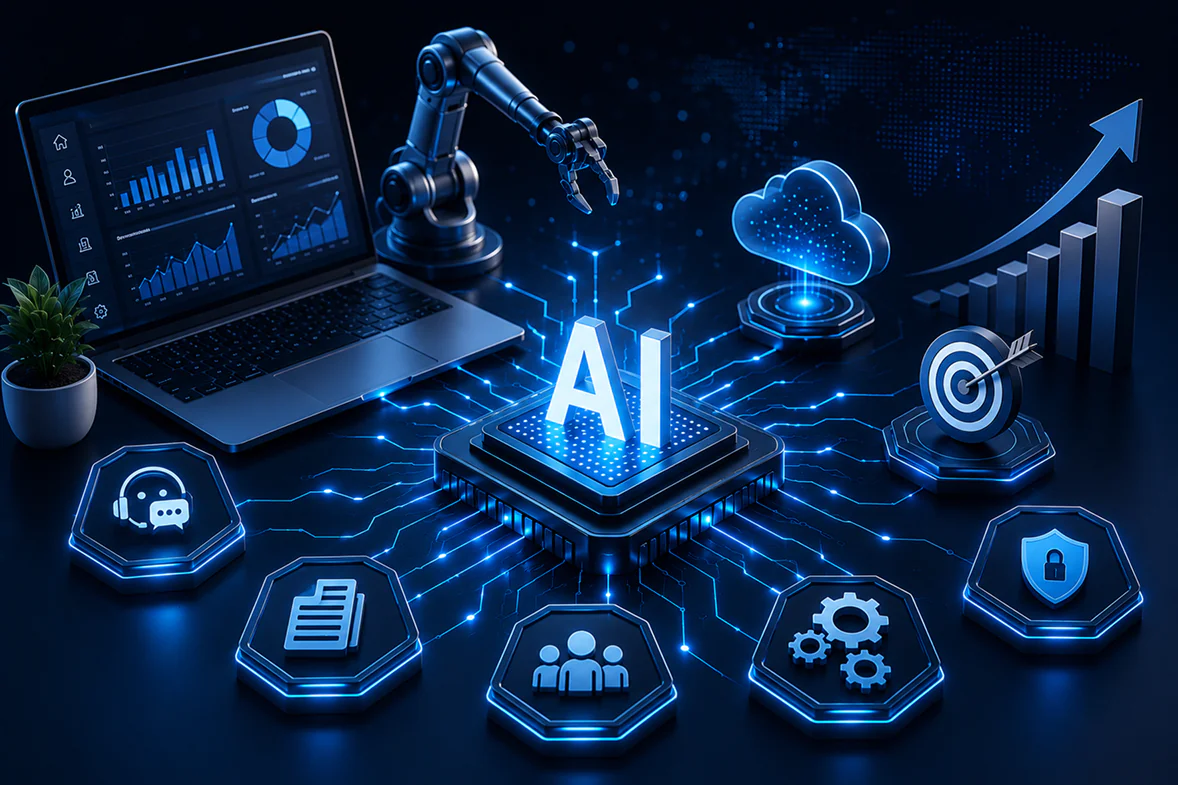
Artificial Intelligence (AI) has become a practical business tool for Indian SMEs—not just large enterprises. From manufacturing and retail to healthcare and education, AI automation helps businesses reduce manual work, improve efficiency, lower operational costs, and deliver better customer experiences.
Whether you run a textile business in Surat, a manufacturing company in Ahmedabad, or a retail chain in Mumbai, AI can streamline operations, automate repetitive tasks, and support sustainable business growth.
Why Indian SMEs Need AI Automation in 2026
Indian businesses are becoming increasingly digital. Customers expect instant responses, employees expect efficient workflows, and business owners want better visibility into operations.
Unfortunately, many SMEs still rely on:
- Manual data entry
- Excel spreadsheets
- WhatsApp-based order management
- Paper documentation
- Repetitive customer support
- Time-consuming approval processes
These traditional methods slow down growth and increase operational costs.
AI automation solves these challenges by enabling businesses to:
- Streamline operations
- Eliminate repetitive tasks
- Digitize workflows
- Improve efficiency
- Reduce manual effort
Businesses that adopt AI early gain a competitive advantage over those that wait.
What is AI Automation?
AI Automation combines Artificial Intelligence (AI) with workflow automation to enable software systems to perform repetitive tasks, analyze data, make intelligent decisions, and continuously improve over time. Unlike traditional automation, AI can learn from data, recognize patterns, and adapt to changing business requirements. `
Instead of employees performing repetitive work manually, AI systems can:
- Understand data
- Analyze information
- Make intelligent decisions
- Generate content
- Answer customer questions
- Process documents
- Predict trends
- Automate workflows
Unlike traditional automation, AI continuously learns and improves with more data.
Benefits of AI Automation for SMEs
1. Increased Productivity
Employees spend less time on repetitive administrative work and more time on strategic activities.
Examples include:
- Invoice processing
- Data entry
- Report generation
- Lead qualification
2. Reduced Operational Costs
Automation reduces:
- Manual errors
- Hiring requirements
- Processing delays
- Administrative expenses
Businesses often recover their AI investment through increased efficiency.
3. Faster Customer Support
AI chatbots provide:
- 24/7 support
- Instant replies
- Lead collection
- Appointment booking
- Product recommendations
Customers receive immediate assistance without waiting for business hours.
4. Better Decision Making
AI dashboards analyze:
- Sales performance
- Customer behavior
- Inventory
- Marketing campaigns
- Financial reports
Business owners can make informed decisions based on real-time insights.
5. Improved Employee Experience
Instead of replacing employees, AI assists them.
Employees can focus on:
- Customer relationships
- Innovation
- Sales
- Strategy
- Business development
Step-by-Step AI Automation Roadmap
Phase 1: Business Assessment
Every successful AI implementation begins with understanding your existing processes.
Ask questions like:
- Which tasks consume the most time?
- Which departments are overloaded?
- Where do delays occur?
- What processes are repetitive?
Map your workflows before selecting AI solutions.
Departments to Evaluate
- Sales
- Marketing
- HR
- Finance
- Operations
- Customer Support
- Inventory
- Procurement
Phase 2: Define Clear Business Goals
Avoid implementing AI simply because it’s trending.
Instead, define measurable objectives.
Examples:
- Reduce customer response time by 80%
- Automate invoice generation
- Increase lead conversion
- Improve employee productivity
- Reduce operational costs by 30%
- Automate HR onboarding
Clear goals ensure measurable ROI.
Phase 3: Prioritize High-Impact Processes
Not every process needs AI.
Start with tasks that are:
- Repetitive
- Rule-based
- Time-consuming
- High-volume
- Error-prone
Examples
Customer Support
- FAQs
- Ticket routing
- Live chat
Finance
- Invoice processing
- Payment reminders
- Expense approvals
Marketing
- Content generation
- Social media scheduling
- Email campaigns
Sales
- Lead qualification
- CRM updates
- Proposal generation
HR
- Resume screening
- Interview scheduling
- Employee onboarding
Phase 4: Build Your Digital Foundation
AI performs best when connected to organized digital systems.
Ensure your business has:
- Website
- Mobile App (if required)
- CRM
- ERP
- Inventory Management
- Cloud Storage
- Digital Documents
Businesses using disconnected systems often struggle with AI implementation.
Phase 5: Collect Quality Data
AI is only as good as the data it receives.
Organize:
- Customer database
- Sales records
- Product catalog
- Employee information
- Financial data
- Inventory records
Remove duplicate or outdated information before deployment.
Phase 6: Choose the Right AI Tools
Different business problems require different AI solutions.
Popular AI categories include:
AI Chatbots
Handle customer inquiries automatically.
AI Voice Agents
Answer incoming calls and book appointments.
AI CRM Automation
Automatically nurture leads and update customer records.
AI Marketing Tools
Generate blogs, emails, ad copies, and social media content.
AI Document Processing
Extract data from invoices, PDFs, and forms.
AI Analytics
Generate business insights using real-time dashboards.
AI Workflow Automation
Connect software and automate repetitive tasks across departments.
Phase 7: Start Small
Many SMEs fail because they attempt full automation immediately.
Instead:
Choose one department.
Launch one AI project.
Measure results.
Expand gradually.
This reduces risk and increases adoption.
Phase 8: Employee Training
Technology succeeds only when employees embrace it.
Provide training on:
- AI tools
- Best practices
- Workflow changes
- Security
- Data privacy
Employees should understand that AI assists rather than replaces them.
Phase 9: Measure Results
Track Key Performance Indicators (KPIs) such as:
- Time saved
- Cost reduction
- Customer satisfaction
- Employee productivity
- Sales growth
- Error reduction
- Revenue increase
Continuous monitoring ensures maximum ROI.
Phase 10: Scale Across the Business
After successful implementation:
Expand automation into:
- Manufacturing
- Procurement
- Logistics
- Marketing
- Customer Support
- HR
- Finance
Gradual expansion creates sustainable digital transformation.
AI Automation Use Cases Across Industries
Manufacturing
- Predictive maintenance
- Inventory optimization
- Quality inspection
- Production scheduling
Textile Industry
- Order management
- Dealer management
- Inventory forecasting
- Customer support automation
Healthcare
- Appointment booking
- Patient management
- Medical record automation
- Follow-up reminders
Retail
- Product recommendations
- Inventory management
- AI customer support
- Sales forecasting
Real Estate
- Lead qualification
- Property recommendations
- Automated follow-ups
- CRM automation
Education
- Student inquiries
- Admission automation
- Attendance systems
- Course recommendations
Common Mistakes to Avoid
Many SMEs struggle with AI because they make avoidable mistakes.
1. No Clear Strategy
Buying AI tools without business goals.
2. Poor Data
Incomplete or inaccurate data leads to poor AI performance.
3. Automating Everything
Focus only on high-impact processes initially.
4. Ignoring Employees
Include your team throughout implementation.
5. No ROI Tracking
Measure success using defined KPIs.
How Much Does AI Automation Cost?
AI automation costs vary depending on:
- Business size
- Number of users
- Required integrations
- Custom development
- AI models used
For SMEs, the best approach is to begin with a pilot project. This allows businesses to validate results, calculate ROI, and expand gradually rather than making a large upfront investment.
Remember, the real value of AI is not just in reducing costs—it lies in improving efficiency, enhancing customer experience, and creating opportunities for sustainable growth.
Future of AI for Indian SMEs
Over the next few years, AI will become a standard part of business operations.
Businesses will increasingly adopt:
- AI Agents
- Voice AI
- Predictive Analytics
- Autonomous Workflows
- Intelligent CRM Systems
- AI-powered ERP
- Hyper Automation
- Personalized Customer Experiences
Organizations that embrace AI today will be better positioned to compete, innovate, and scale in tomorrow’s digital economy.
Why Choose Codzcart Infotech Pvt. Ltd. for AI Automation?
At Codzcart Infotech Pvt. Ltd., we help businesses transform their operations with practical and scalable AI solutions tailored to their needs.
Our AI Automation Services include:
- AI Strategy & Consulting
- AI Workflow Automation
- AI Chatbot Development
- AI Voice Agents
- CRM & ERP Automation
- Business Process Automation
- Custom AI Solutions
- Website & Mobile App Integration
- Custom Software Development
- AI Analytics & Reporting
Whether you’re just starting your AI journey or looking to optimize existing processes, our team can help you build a roadmap that delivers measurable business value.
Conclusion
AI automation is no longer a luxury—it’s a necessity for businesses that want to grow and stay competitive. By following a structured AI roadmap, Indian SMEs can streamline operations, reduce costs, improve productivity, and deliver better customer experiences.
Ready to transform your business with AI? Partner with Codzcart Infotech Pvt. Ltd. and start your journey toward smarter, faster, and future-ready business automation.