
Modern businesses depend on data for almost everything. Software teams use it to test applications, AI teams use it to train models, and analysts use it to understand customer behavior and business performance.
But there is a problem.
Real business data often contains sensitive information.
Customer names, phone numbers, email addresses, financial details, medical records, transactions, and other personal information cannot always be freely copied into development or testing environments. At the same time, teams still need realistic data to build and improve their systems.
This is where synthetic data becomes useful.
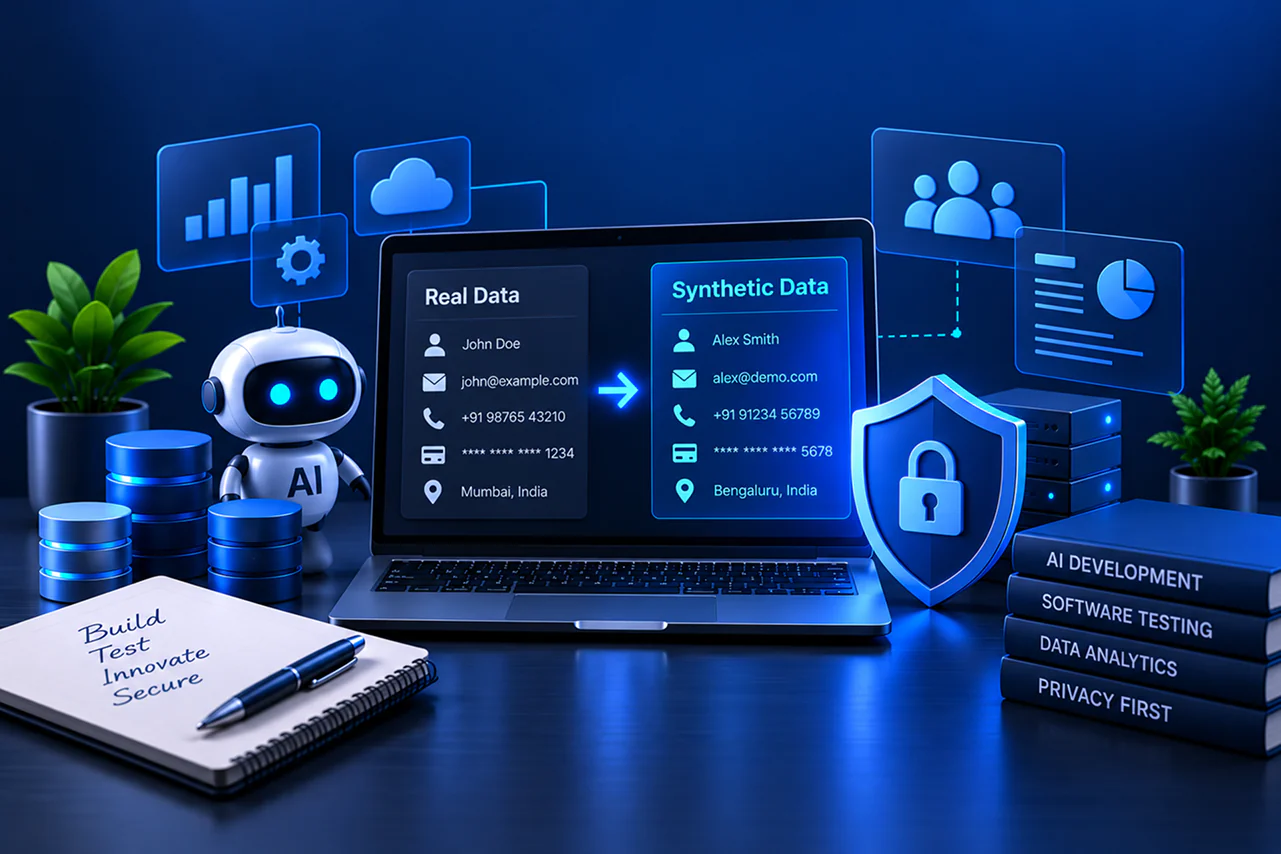
Synthetic data is artificially generated data that is designed to behave like real-world data without directly exposing the information of real customers. It can help software and AI teams work with realistic datasets while reducing their dependence on sensitive production data.
What Is Synthetic Data?
Synthetic data is data created artificially using algorithms, statistical models, simulations, or AI rather than being collected directly from real individuals.
For example, imagine an e-commerce company has millions of real customer records containing:
- Customer names
- Product purchases
- Order values
- Locations
- Payment information
- Browsing behavior
Instead of giving developers direct access to these records, the company can generate a synthetic dataset with similar patterns.
The names and details are fictional, but the dataset can still represent realistic purchasing behavior.
This allows teams to work with useful data without unnecessarily exposing real customer information.
Why Are Businesses Using Synthetic Data?
The biggest reason is simple: teams need data, but they also need to protect it.
Traditionally, developers might use production data for testing because it represents real customer behavior. However, this can create privacy, security, and compliance risks.
Synthetic data provides another option.
A development team can create thousands or millions of artificial records that match the structure and statistical characteristics of real data.
This is especially useful when working on systems involving sensitive information.
For example, a healthcare software company may need patient-like records to test appointment systems, reports, or analytics features. Using fictional patient data can make testing easier without exposing actual patient records.
How Is Synthetic Data Generated?
Synthetic data can be generated in several ways depending on the use case.
1. Rule-Based Generation
The simplest approach is to create data using predefined rules.
For example, a system could generate:
- Random customer names
- Different age groups
- Various locations
- Product categories
- Order values
- Purchase dates
This method is relatively simple and works well for basic software testing.
2. Statistical Models
More advanced systems study patterns within an existing dataset and generate new records that follow similar statistical characteristics.
For example, if real data shows that younger customers tend to purchase certain product categories more frequently, a synthetic dataset can reproduce a similar pattern without copying individual customer records.
3. AI and Machine Learning
AI models can also be used to generate synthetic data.
A model can learn relationships and patterns from an existing dataset and then generate new examples based on those patterns.
This approach is becoming particularly interesting for AI development, where large and diverse datasets are often required.
Synthetic Data for Software Testing
Software testing is one of the most practical applications of synthetic data.
Developers need different types of data to test how an application behaves under different conditions.
For example, an e-commerce application might need to test:
- New customer registrations
- Large numbers of orders
- Failed payments
- Product returns
- Discount codes
- Different delivery locations
- High-volume transactions
Creating all these scenarios manually can take a lot of time.
Synthetic data can generate large test datasets quickly and help developers test applications under different conditions.
It can also make it easier to perform load testing, where teams want to understand how an application behaves when thousands or millions of records are processed.
Synthetic Data for AI Development
AI systems depend heavily on data.
However, collecting enough high-quality real-world data can be difficult, expensive, or restricted because of privacy concerns.
Synthetic data can help fill some of these gaps.
For example, an AI team building a customer support system may need thousands of different conversations to test how the system responds to customers.
Instead of using real conversations containing personal information, teams can generate fictional conversations covering different situations.
Synthetic data can also help create examples for uncommon situations that may not appear frequently in real datasets.
This can be useful when developing and testing AI models that need to handle a wide range of scenarios.
Synthetic Data for Analytics
Analytics teams also need large amounts of data to test dashboards, reports, and business intelligence systems.
Imagine a company is developing a new sales dashboard.
The dashboard may need to display data for thousands of customers, products, regions, orders, and transactions before it is ready for production.
Using synthetic data allows the analytics team to work with realistic-looking information without giving every developer or analyst access to sensitive customer records.
This creates a safer environment for development and experimentation.
Key Benefits of Synthetic Data
Synthetic data is becoming increasingly valuable because it offers several practical benefits.
Better Data Privacy
One of the biggest advantages is reducing the need to expose real customer information during development and testing.
Faster Development
Teams can generate large datasets quickly instead of manually collecting or preparing test data.
More Testing Scenarios
Developers can create specific situations that may be difficult to find in real-world data.
Easier Data Sharing
Synthetic datasets can sometimes be shared more easily across development teams, vendors, or testing environments because they do not contain the same direct customer information as production data.
Support for AI Innovation
AI teams can use synthetic data to experiment, test models, and explore scenarios where real-world data may be limited.
Is Synthetic Data Always Better Than Real Data?
Not necessarily.
Synthetic data is useful, but it is not a complete replacement for real-world data.
The quality of synthetic data depends heavily on how it is generated.
If the generated dataset does not accurately represent real-world patterns, teams may make incorrect assumptions. Poorly generated synthetic data can also introduce bias or miss unusual cases that occur in real environments.
For this reason, businesses should carefully evaluate synthetic datasets before using them for important AI, analytics, or software decisions.
In many cases, the best approach is a combination of real data, properly protected, and synthetic data.
The Future of Synthetic Data
As businesses adopt AI, automation, analytics, and data-driven software, the demand for usable and privacy-conscious data will continue to grow.
Synthetic data offers a practical way to balance these two needs.
It allows teams to ask an important question:
How can we work with realistic data without unnecessarily exposing the people behind that data?
For software teams, it can make testing faster. For AI teams, it can expand available training and testing scenarios. For analytics teams, it can provide realistic datasets for dashboards and experimentation.
Synthetic data is therefore becoming more than just a testing technique. It is becoming an important part of how modern teams approach data privacy, AI development, software testing, and analytics.
Conclusion: Building With Data Without Putting Real Data at Risk
Data is essential for building better software and smarter AI systems. But access to data should not come at the cost of customer privacy.
Synthetic data provides a practical middle ground.
By generating realistic but artificial datasets, businesses can test applications, develop AI systems, build analytics solutions, and experiment with different scenarios while reducing unnecessary exposure to sensitive customer information.
The goal is not to replace real data completely. The goal is to use data more responsibly.
As AI and software development continue to evolve, synthetic data is likely to become an increasingly important tool for teams that want to build faster, test smarter, and protect customer information.